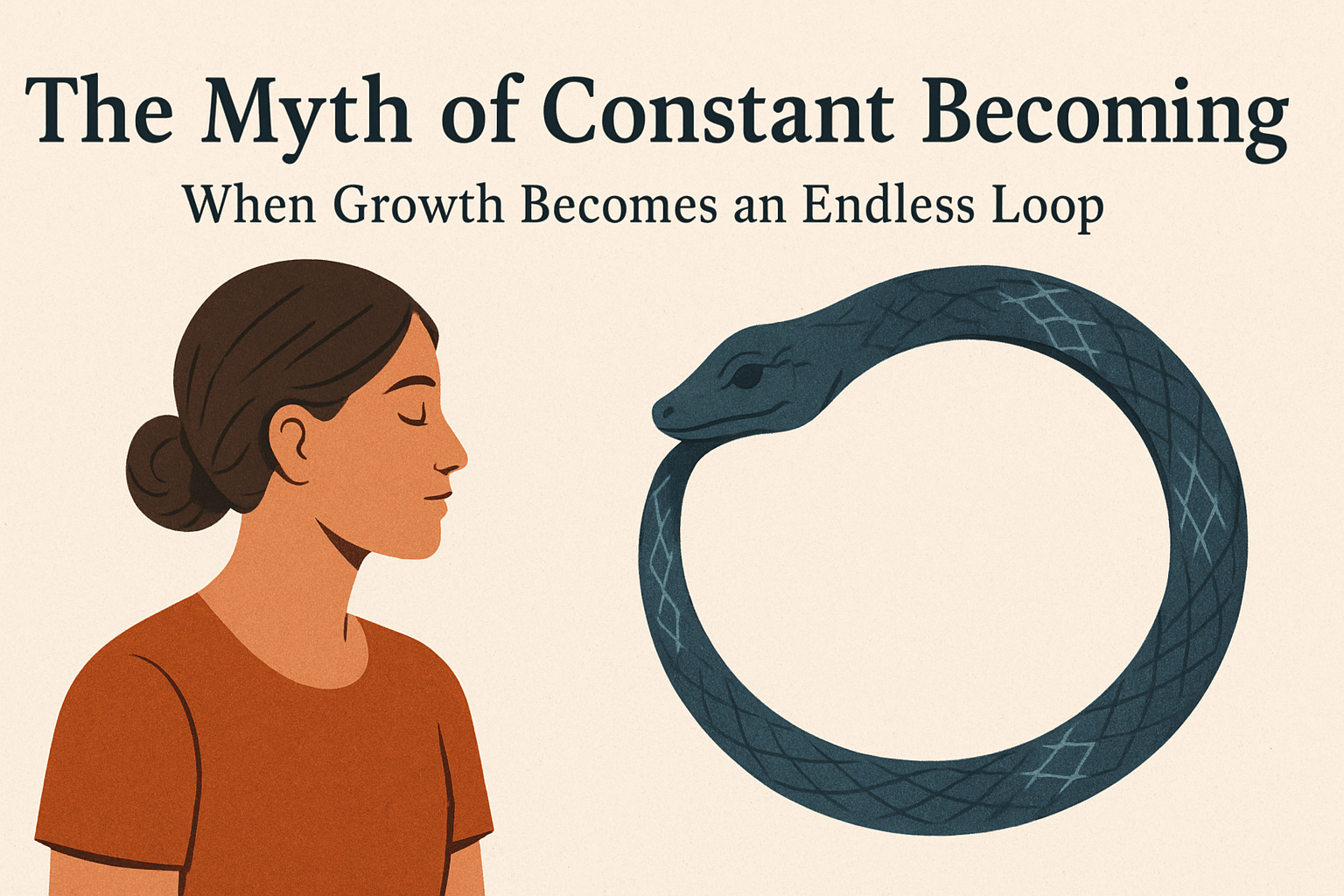
The Myth of Constant Becoming — When Growth Becomes an Endless Loop
We exist in an age obsessed with progress – where any stillness feels like loss and every person must be better than their previous version. The act of “becoming” has shifted from an open-ended journey into an implied expectation that is constantly buzzing just beneath us all. We are forever optimizing, refining, evolving, and yet somehow never arriving. This essay will explore that subtle exhaustion behind that chase, and consider what it might mean to just “be” without chasing the next “becoming.”
The Growth That Is Actually a Productivity Trap
At some point, growth shifted from being about fulfillment to performance. We began to treat personal growth like a full-time job; we tracked habits, made micro-goals, and opted into “high-performance living.” Rest has even become a means to an end: sleep better to endure harder work, meditate to be able to focus longer. Growth that used to be about inner expansion has now been measured by output, or efficiency. We are told to “keep improving,” and the performative nature of it all never lets us rest long enough to feel improved. The productivity trap veils itself within self-help quotes and morning routines, nudging us to pay attention to when we’re not evolving at all for fear of falling behind. But maybe real growth is not ongoing motion; maybe growth is being aware of when it is time to stop, to breathe, and to just live without a checklist. At times, my act of growth is to use my agency not to optimize, but to be. To just be without purpose or progress tied to it.
The Fear of Stagnation
In a culture that celebrates momentum, stillness, on occasion, can feel like failure. We have been conditioned to accept the notion that if we are not moving forward, we are being left behind — that stasis is a death of sorts (just quieter). So we fill in any pause with some new project, course, or transformation; anything to prove that we are not stuck. However, this motion does not come from a place of desire, it comes from fear — the fear of being uninteresting, of not having a new story to tell. The reality is that growth can feel disabled, it can feel like maintenance, or it can feel like simply enjoying being where you are. In its mildest form, stagnation can be healing. It is a pause to assimilate, but not regurgitate. We forget that even nature undertakes inertia — the seasons churn, the tides ebb, and yet we expect ourselves to bloom an infinite number of times. Instead of being stagnated, perhaps we are simply letting ourselves breath.
The Vanishing Finish Line
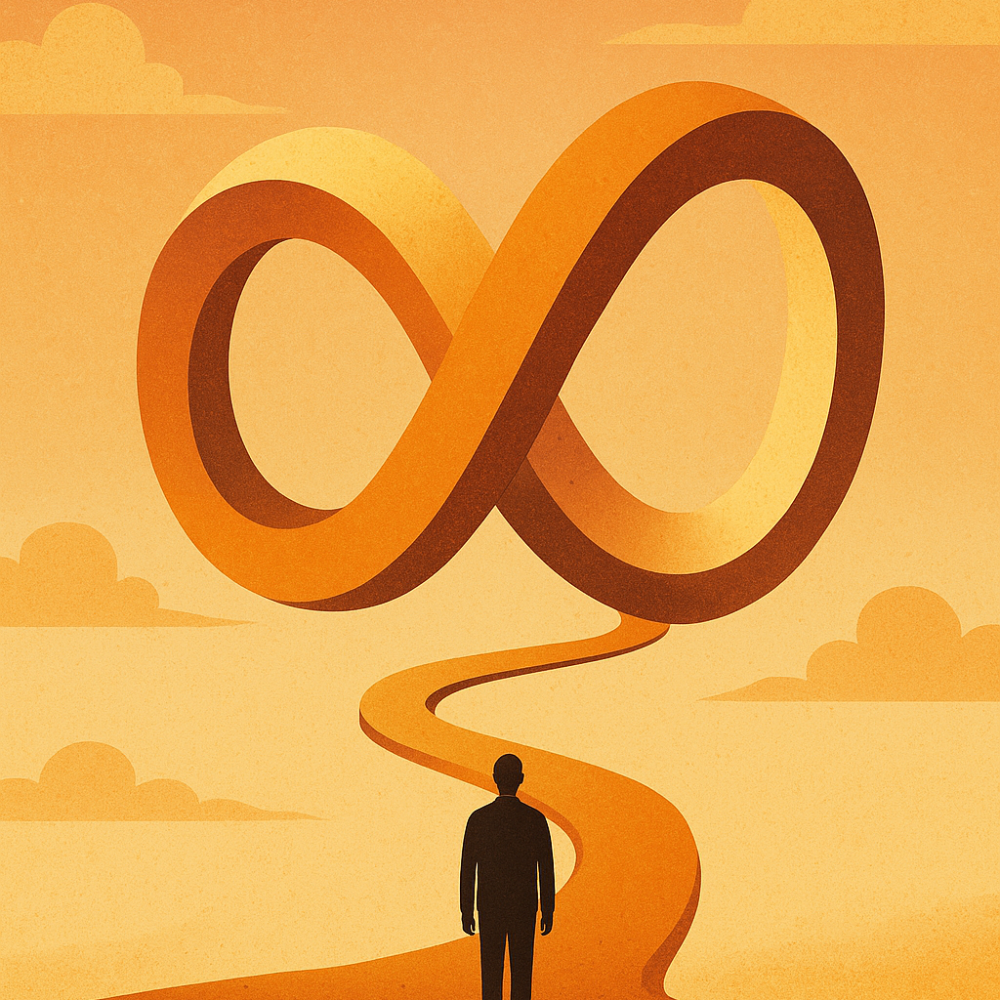
Here is the curious thing about self-improvement — there is no finish line, and the finish line keeps moving. Even when we achieve a goal, the horizon expands just a bit further, reminding us that there is more to fix, or more to become. What feels like motivation starts to become a slight ache — a realization that no matter what we achieve or how much we grow, we are never complete. It’s like running in a never-ending race. And it’s not made any easier with the onslaught of social media reminding us that there is always a newer iteration of “better”: fitter, calmer, richer, more mindful. Our current self are simply drafts, constantly being updated. The issue is not wanting more: the issue is never feeling enough. We conflate progress with worthiness, and in doing so, we lose weight of our initial chase. The disappearing finish line leaves us restless; constantly obtaining, seldomly satisfied. Perhaps we were never meant to arrive at the finish line at all — but rather we were meant to know we were whole before we started.
The Skill of Being Over Becoming
At a certain point, self-improvement must give way to self-acceptance. Being does not equal giving up; it means acknowledging who you are in the moment without having to constantly upgrade. It is sitting in your own skin and saying to yourself, “This is enough for today.” In a culture that romanticizes change, stillness can feel like an act of rebellion. Yet learning how to be – truly be – is one of the most peaceful types of growth. It is about presence, not progress. About depth, not direction. When we stop chasing toward our potential for a moment, we get to meet ourselves just as we are without anything other than ourselves in that moment. This is not to say that the journey stops, it just changes shape; it becomes softer, slower, more human. The art of being reminds us that growth was never the goal, it was aliveness. And sometimes, the most beautiful thing we can become is comfortable with ourselves, who we already are.
Conclusion
At some point, we have to shift from approaching life as a project into experiencing life as a journey. Growth was never meant to be a linear ladder — it was meant to be a rhythm, which has changing seasons as well as calm seasons. The never-ending push to become can quietly work to solicit us from the simple joy of being. Perhaps the real development happens not when we try to improve ourselves, but when we have arrived.